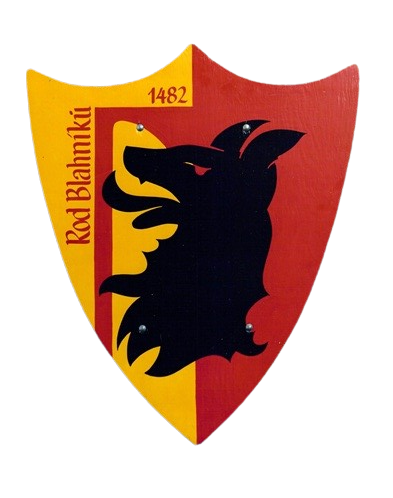
Blahnik History
Note: Those interested in Blahnik genealogy are encouraged to visit blahnik.genealogyvillage.com an excellent website edited by Lori Dollevoet, daughter of Bette Jane Blahnik. Read an article by Lori, "The Blahnik DNA Project" in the December 2013 issue of Nase Rodina, a Czech Genealogical Society Publication.
Synopsis
1. European Origins and the Blahnik Mill
This family history traces back to Bohemia (the modern-day Czech Republic), primarily centered around the village of Smrzovice and the historic Blahnik Mill (Mlyn). The narrative tracks generations of land and mill transitions—such as Jakub Blahnik inheriting a family mill in 1737 under the Koutsky Dominion—detailing the strict inheritance laws, royal obligations, and familial splits of the 18th century as the population expanded and house numbers were officially assigned to separate branches of the family.
2. Migration and Early Settlement in Wisconsin
A major focal point of the history is the family's migration to the United States during the mid-19th century:
The Pioneer Journey (1855): Among the earliest recorded settlers in what is now the Town of Ahnapee (near Algoma in Kewaunee County, Wisconsin) were George Blahnik Sr. and his wife, Katherine (Blaha) Blahnik.
The Atlantic Crossing: The couple left Bohemia with five sons (Mathias, Jacob, George Jr., Joseph, and John) and a daughter. Tragically, their daughter died during the arduous Atlantic crossing. A sixth son, Anton, was later born in the United States.
Carving Out a Homestead: Upon arriving in northeastern Wisconsin in 1855, the family purchased 80 acres of dense timberland. They faced severe pioneer hardships as they cleared the wilderness by hand to establish a functional farm. Over time, George Sr. expanded the estate by purchasing an additional 240 acres of land.
3. Lasting Legacy
The original homesteaded land was passed down through the generations, eventually becoming the property of great-grandson Donald Blahnik (son of Jacob A.Blahnik). The family patriarch and matriarch, George Sr. and Katherine, lived out their lives on the land, passing away in 1893 and 1891 respectively, and were laid to rest in St. Mary’s Cemetery in Algoma, Wisconsin.
This history serves as a gateway for the broader genealogical tracking featured here; anchoring the lineage of site creator Leon "Lee" Blahnik—a U.S. Air Force veteran and retired Wisconsin educator—to these original Bohemian-American pioneers.
(Gemini AI generated Synopsis)
Authenticity
The following Blahnik history and related information was provided courtesy of Joel Blahnik of Fish Creek, Wisconsin. Joel Blahnik is a nationally recognized music educator, conductor and composer whose published works have been performed around the world by school and professional organizations. His manuscripts have been featured at national composer symposiums, recorded by state and national radio and have appeared on foreign radio and television. As a musicologist and researcher his specialty is Czech music, of which he is considered a scholar.
He is the co-founder of the Czech Music Alliance. His recreation is the water where he has served as a Coast Guard skipper on Lake Michigan and as a lighthouse caretaker and historian. Joel is the son of Arthur Blahnik. During the summer of 1973, Joel and his father, Arthur, journeyed to Czechoslovakia where they did music research and where Arthur obtained the full history of the Blahniks.
This history was compiled by a superb scholar, Ladislav Blahnik, now deceased, who was a Governor of the north-eastern section of Bohemia prior to World War II, and then became a political prisoner for 10 years under the succeeding Communist regime. It was his zeal for compiling and editing the family history which made him survive the ordeals of that time. The family history represents a tremendous amount of research and focuses on the point that all who are named Blahnik came from the same root.
Condensed History of Blahniks in Wisconsin
Among the first settlers in the area today known as the Town of Ahnapee were George and Katherine Blahnik. They and five sons arrived in the United States in 1855 and came directly to northeastern Wisconsin, purchasing 80 acres of timberland in Ahnapee town. George Blahnik was reared on a farm in Bohemia and married Katherine Blaha, also a Bohemian by birth. The marriage was performed in Bohemia.
The five sons who arrived in Ahnapee town with George and Katherine were Mathias, Jacob, George, Jr., Joseph and John. When the Blahnik family left Bohemia in 1855, there was also a daughter. She however, died during the Atlantic crossing. Later a sixth son, Anton, was born in this country. Upon their arrival and their purchase of 80 acres of Ahnapee timberland, the Blahniks began to clear it for farming. George, Sr., eventually purchased an additional 240 acres, all of which he improved.
The Blahniks experienced many hardships incident to the life of a pioneer. The buildings which they erected are no longer in existence, but the land became the property of Donald Blahnik, a great-grandson of George and Katherine. Donald's father was Jacob A. Blahnik. Katherine died in 1891 and George's death took place in 1893. They were buried in St. Mary's cemetery, Algoma, Wisconsin.
Ladislov Blahnik: Letter Number One from Ladislav Blahnik Hradec Kralove, Czech, to Joel Blahnik, USA 1966
Dear Joel,
I send you and your wife, Mary Ann, and all your relatives all my greetings and my heartfelt thanks for both of your letters. With great interest and joy we read about your life and artistic successes and also the successes of others in the Blahnik family in the state of Wisconsin. We were really glad to hear that you were pleased with your brief stay in Czechoslovakia.
We are only sorry that we did not know about your trip soon, then we would have had a chance to meet personally. We hope you will come back soon and our desire to meet you in person will come true. In the meantime, we will be satisfied with letters about the roots of our ancestry in which you have shown such unusual interest. I am going to answer at this time a few questions from your letter after my conversation with my brother, Petr. Frank Roubik in his voluminous scientific work which is called The History of the Chods from Domazlice (Taus), writes about the name ‘Blahnik’ on the list of the oldest families in the tribe of Chods.
This family gave its name to a water mill and a big farm on the creek, Andelka, between the villages of Lhota and Pocinovice. According to the old tax rolls it was a mill with one wheel and a farm of 60 acres, 9 teams of horses, 5 cows, 9 heifers, 16 sheep, and 20 pigs. This place is still called "Blahniky" or "By Blahniks," and is registered on all, even the oldest maps of the country and also on a very old map preserved in the Prague Castle. This farm was later divided into four parts among the children.
This is the present condition, but the proprietors have different names. The mill was used until World War II (about 1940) but is not operating anymore. From this place the family of Blahnik spread into the neighboring counties of Klatovy and Domazlice. Some of them were owners of mills on Andelka Creek and Uhlava River. Some of them went to the city of Klatovy, others were farmers near the neighboring villages.
In the 19th century and especially the 20th century they emigrated further into the cities of Bohemia. Among the most famous was Adelburt Christian Blahnik for whom a street was named in Prague as you noticed. He was a writer of historical plays. He was an historian who wrote the history of the theatre entitled, The World History of the Theatre and also The Idea And Nature of Theatrical Art and other books.
There is one other man living in Prague whose name is Frank Blahnik, a popular accordionist, whose brother, Roman, is a music composer. Donna Blahnik, an actress, also lives in Prague. The Sons of Frank Blahnik played as children in the movies. East of Prague in the city of Sadska about 15 years ago lived a miller named Blahnik. He was the last miller in the family. Before that, there was a miller Blahnik in Dobrikov, ½ hour (walking) west of Smrzovice. The last one in Dobrikov between the two World Wars sold his mill and bought a farm near Plzen. There are many Blahniks at present in the following cities besides in the counties of Klatovy and Domazlice: Plzen, Prague, Budweis, Koeniggretz, Jicin, Kuttenberg, Machod, Cerveny Kostelec, Bruenn, Moravska Ostrava, and other places.
According to professions they are; clerks, teachers, professors, technicians, salesmen, doctors, pharmacist, a general, a Catholic priest, employees in industry, and others. In the meantime, the oldest probable mention of the Blahnik family is in the Latin writing of the Chods from November 15, 1430, in which is registered the Blahnik name. Blasius Hoden de Pocinovice — It is possible that this is the Latinized name from which the name Blahnik developed. But because there is not exact proof for the above, we started our family chronicle with the year 1482 when in the village of Libkov, about 3 kilometers east of Smrzovice, lived in the free territory of the Chods, a farmer, Ondra Blahnik. He didn’t forget his free origin and he tried to gain a higher social rank. His son, Martin Blahnik, succeeded and bought in the same village of Libkov from the nobility, a free farm called "Snopkovsky dvur," and in this way he and his heirs became free men (not subjected to serfdom). This above mentioned Martin called himself Blahnik.
The free class had at that time more liberties and freedom than the Chods had. They (Chods) were rich farmers and had access to education and they were the link between the ordinary farming class (serfs) and the nobility. They were directly subject to the king and their farm was listed in the royal register in Prague. Their affairs were handled directly by the royal officers. Out of this free class of Chods came many representatives of farmers, namely, in the Hussite time (15th century) and later. Also the spiritual and political leaders of the Czech nation came from their ranks. Martin Blahnik bought the farm at Libkov for 3000 gulden. The contract was made in the year 1505 on the feast of St. Gregory. The last registration of the family Blahnik on the above farm is from the years 1571-1579 when the owner was registered as Hron Blahnik. Then the farm changed hands. No contract is available.
From the same time there are proofs about the Blahnik family from the mill in the village of Lhota, one kilometer south of Smrzovice and also in the mills on the Andelka Creek, especially in the place called "By Blahniks." Perhaps we might succeed later on through research to find out where the family was earlier. The list of the oldest members of the Blahnik family: 1.) Ondra Blahnik - farmer in Libkov 1482. 2.) Martin Blahnik and his wife, Lidmilla, in Libkov, free men, farmer in Snopkov. 3.) N. Blahnik - free man in Libkov on farm Snopkov, 1571-79. 4.) Hron Blahnik - free man in Libkov on farm Snopkov. 5.) N. Blahnik - in mill near Lhota 1599. 6.) Matthew Blahnik - in the mill near Lhota 1622-54. 7.) Martin Blahnik - in the mill near Lhota 1652 8.) James Blahnik, Sr. - owned ¼ of the ‘By Blahniks’ mill 1696. Died in 1701. 9.) Simon Blahnik - owned ¼ of the mill ‘By Blahniks’ & his wife, Barbara. 10.)Peter Blahnik - owned ¼ of farm ‘By Blahniks’ listed 1719-45. 11.) Wenceslaus Blahnik - owned ¼ of farm ‘By Blahniks’ with wife Margaret 1745. 12.) Martin Blahnik - born Sept. 20, 1760, son of Wenceslaus Blahnik & married Katherine Votruba, daughter of James Votruba—farm and village leader in Smrzovice. He farmed ½ of the farm and is the founder of the Blahnik household in Smrzovice #16 (Blahniks still living there today). 13.) James Blahnik - born March 21, 1785 — wife Margaret, daughter of James Votruba. 14.) Joseph Blahnik - born August 14, 1829. Died in 1912. His wife was Magdalen Votruba (1832—1914) 15.) James Blahnik - born January 5, 1863. Died September 21, 1931. Wife was Ann Sedlacek, died July 2, 1936 (Our parents).
The members of our family were predominantly millers. Millers were free people and in national life they belonged to the class of intelligent, educated, and nationally and politically progressive people. The proofs of this for the family tree were found in the Archives in Prague, Klatovy and in the church parsonages.
Chodove (Chods) - The Chods were the farming class of people who settled in the Bohemia - Bavarian boundaries about 900 years ago. Besides their profession as farmers, they were delegated to guard the boundaries between Germany & Bohemia, especially the roads in Boehmerwald. Their villages were conveniently located in the country and were built is such a way so that they could be defended, if need be. Chods were divided into 3 groups, geographically: 1.) The Taus Chods, guarding the exit over Klenci to Taus Vseruby Pass, Eisenstein Route to Klatovy; 2.) The Tachov Chods who guarded the territory north of Taus; 3.) The third was the Royal Men whose territory belonged directly to the King.
The Chods were privileged for their services by the King with many social and other privileges which the new Kings cheerfully confirmed. In the course of peace time toward Bavaria their duty ceased to exist. Ethographically, the second and third group (Tachov & the Royal Men) ceased to exist, only the Chods of Taus kept the Czech language and customs until today. They kept their privileges until the end of the 17th century, but not all of them, 11 villages only - in the western corner of Bohemia.
Apparently their territory was very important for a long time. Of all Slavs, these Chods are geographically located farthest westerly. Before the end of the 17th century, they lead the rebellion against the new owner of their territory whose name was Lamminger. He canceled all their privileges. Their cause was lost. The kings from Vienna never confirmed their privileges. The above mentioned tragic fight for freedom was glorified by the novelist of the 19th century, Alios Jirasek, in his famous novel, Psohlavci. The central figure in the novel is John Sladky-Kozina, who was executed in Plzen in 1695.
The Chods of Taus used the hounds for guarding the borders and on their flags they had the emblem of the dog’s head as a sign of faithfulness and watchfulness!
At the head of each village was the village leader. The rebellion was carried out by the people of Klenci, Postrekov, Drazenov, Luzenice, Chodov, Ujezd, Straz, Mrakov, Klicov, Lhota, & Pocinovice. Besides the novelist, Jirasek, there is a Catholic priest, Fr. Henry Simon Baar, a native of Klenci. At his grave in Klenci in 1925 my brother Jaroslav gave a eulogy for the farm youth. The other native of Klenci is a famous teacher and music composer, Jindrich Jindrich, who collected and edited thousands of songs and ballads. Opera composer, Charles Kovarovic, composed the opera Psohlavci in 1905.
On the same name, the story was made into a movie. Through the same routes which were guarded through the centuries the U. S. Army came in 1945 to liberate the country. World War II ended here. Only a few shots were exchanged. The Chods greeted the American soldiers very enthusiastically at that time.
Votruba Family - James Votruba was a farmer and village leader in Smrzovice. He was not free, subject to the landowner. In Kout na Sumava he lived on the biggest farm in the community and had a large garden edged by a stone wall. In the 18th century, because of the population explosion, even his farm was divided into two identical parts. One farm was inherited by his son, John, who married Margaret Blahnik and the other half was given to Katherine who married Martin Blahnik. The Votruba family lives on the same farm today. Both establishments are at present time deteriorating because the private ownership was taken over by the state. The young people are looking for better paid jobs in the cities.
Blanik - Blanik is a mountain in the center of Bohemia surrounded by national stories of the past. There are no direct proofs of connection between the name of the mountain and our family. The name Blahnik does not occur in the land register around the mountain. Frederick Smetana, music composer, perpetuated the fame of the mountain as the 6th and concluding movement of his composition, Ma Vlast (My Fatherland).
Also an interesting item I add is that a few kilometers south of Smrzovice there is a forested mountain on the map called Blahnik. As it is an important vantage point between the German - Czech border, perhaps the knights who are, by legend, in Blanik with Good King Wenceslaus can be paralleled to the duties of the Chods on the Blahnik mountain. This can only be assumed or proposed. Blahnik Mountain is located in an area nearly surrounded by German population. It is possible that the territory belonged, perhaps, in the past to one of our forefathers who used to farm there. The indirect proof of this is that in the village of Haidel in 1630, one of the seven farmers is listed as Blahnik. His name was later on Germanized by the registrar.
John Huss - This Czech religious reformer was burned at the stake on July 6, 1415. This day was a national holiday after World War I until 1948. I recall well the date of July 5, 1944, the day when I completed the history of the Blahnik Family from Smrzovice, 1482-1944. Because our family tree starts in the Hussite times, and at least some of our forefathers were followers of John Huss, it was more or less in the way of style to mention the Huss name as the old archives do.
You will be also interested to know that in Smrzovice, three linden trees were planted in 1915 in memory of the 500th anniversary of John Huss’ death. It was at that time a national political and anti-Austrian action. In our village the action was led by my brother, Peter (My father was at that time the village president). My brother, Peter, who after he graduated in Vienna studied also in Plzen. In 1926 a stone monument was built among those linden trees. This was done by my brother, Jaroslav, and the sketch was made by brother, Otakar.
The speech was made by Professor Machnik of Klatovy who later became Minister of National Defense. When you visit us again, I will show you the monument in the trees. That’s about all very sketchy I can answer of your questions in your letter. The problem of the emblem (the coat of arms) is not solved. It would be possible to look up the emblem in the free branch of our family in Libkov. Such a free man was a nobleman, knight, and also this family member was the link between the vast population and the leaders. Our family didn’t have a coat of arms. Those were distributed by the kings only to individuals for extremely valuable services.
There is no news (recorded) about one in our family. On the cover of our family tree we put a coat of arms of the millers wheel in memory of the main trade of our forefathers. You surely will like it. I could imagine next to it also the coat of arms of the Chods with their flag and then the symbol of some musical instrument, a lyre, and that’s the ground for any ‘ex libris.’ It is the original and also modern and democratic family emblem, expressing the genealogy of the family work, privileges, duties, and also your American presence here. In this letter I will also enclose the pictures of the cross, standing west of our village in the direction of the U.S.A. As you perhaps know, the cross was built by our grandparents in memory of the departure of the first born son, Joseph, your great-grandfather.
To those pictures which are not good because the weather was not good, I would like to add that we never forget our American family branch - only the distance and the sad condition in the world prevented a closer family tie. When I came back six years ago from ten years of involuntary cloister and read our family chronicle, I thought about the happenings and decided my first gift toward it would be to put down the last news about the departure of my four uncles and two aunts to the U.S.A. I tried to catch all the last known news about their departure.
I also wanted to reflect about the outlook toward America in our villages 100 years ago. From this meditation, I quote you the following words about the cross:" Saying farewell took place between the members outside the village. It surely was a touching moment in humanity in the midst of the fields when the parents gave their Life’s blessing to their child -- when the mother begged the son never to abandon his faith and the father seriously advised to get along with people always. Perhaps some neighbor in order to alleviate the emotion said something about getting rich quick and returning soon.
All was followed by the last handshake, last embrace, last kiss, taking the luggage and sitting on the farm wagon and accompanied by family or friends leaving for the place designated by the agency for the immigrants. Perhaps a few back glances, waving, and long last looks to the place where the road disappears on the horizon. And good bye. The people perhaps stand for a while and through their tears, watch them disappear and then slowly turn and without a word, return home. The parents who sent six children in such a way across the sea put on the place of the first farewell a cross with the following - - In memory of the farewell between mother and her first born son on his trip to America.
This cross - the bottom part of stone and the upper part of iron - stood in the neighborhood of our village between four stone columns connected with iron bars. Alone in the path in the fields in the summer and the winter, in all kinds of weather it stood. Sometimes the sun shone upon it. Sometimes the rain or snow fell upon it. Sometimes the winds - mild or gusty - blew. Only for a short while the rose bushes blossom in June - planted at the foot of the cross. The cross stood there the same was as your great grandfather in the new country. During World War I my father planted two chestnut trees next to the cross and the place was gayer.
The trees grew very slowly. Their foliage was growing but very slowly and the cross was still quite visible on our trips to and from the fields, school, and where ever we went. It always reminded us through its lines, of the hardship of life and the sadness of farewell. Slowly the trees took root - the same way as the children of your great grandfather - rooted into the American community. Six years ago I was very surprised that both trees were grown so large, so that the upper part of the cross was in their branches. When I wanted to see if the cross still carried the image of the Holy Family, I was forced to remove the branches to see. In the front of the cross was a bench and the whole place was so peaceful. It was August when I saw it but I could imagine both trees in full blossom.
At that time I knew hardly nothing about the life of our American relatives. From your letter I know that your family is not a single branch, but rather a mightly and blossoming tree. The odor of the blossoming tree also came to Bohemia (when you came to liberate the country in WWII). The cross was not built in vain! Deeply moved in this beautiful reality, I am quoting the last words of our chronicle:" It is a quick look at America from one of the Bohemian villages which sent in the 2nd half of the last century, its children across the ocean. The majority of our people left for the new world for a better existence. A few of them were led by a desire for adventure in an unknown country. Some of them left because of the law.
But one thing was common to them all. They all had courage. No one was a coward. All were pioneers whose thoughts, ideas, trips, and work cannot leave us apathetic. It is a very interesting and colorful picture of Life. It would be a good ground of cultural and sociological study for future generations.
The stone and iron of the cross is blackened with age. The lettering is eaten by rust. People from the present generation do not know why our grandparents built this monument. At the foot of the cross there is a wild rose bush and thyme and two trees as the stony ground, rough weather, animals, and people let them grow. It is still a lonesome and cultural memorial whose heritage grows with time. It was erected in the time of visible prayer to God for the first born son and also other children to unite them in two different worlds.
We do not know now if they were aware at that time that this Christian symbol of the cross was also the symbol of the spiritual and moral unity which was not to be divided by emigration. From that time, families grew into five generations. That small idea of the unity grew during these 100 years on both sides of the ocean into great ideological and moral and sociological community which benefited the history of mankind and also individuals.
From this point of view, the old cross of the monument, the yellowed photographs, the old hand-written letter of our relatives from America, are a reminder to us of the hardship of life and the eternal longing for new horizons of knowledge and also they are a national memorial to the unity for which the time is here.
And something more. Our grandmother, shortly before her death, wanted to send a picture of this monument to your grandfather. Because my brother, Otakar, sketched so well, she asked him to make a picture of the cross. She gave him a silver five crown coin, but the picture was not made. Now, after more than a half century, Otakar made a photograph of the cross and sends it to you - fulfilling the old wish of grandmother. It is possibly in the history of modern times, the longest time any commission paid in advance took so long to fulfill. Perhaps the buildings of old cathedrals lasted longer.
Let us, not only we, but also our grandparents rejoice in peace that this wish was fulfilled. I will be happy to know that you will recognize from this letter that thoughts of our relatives across the sea are ever present.
Sincerely,
Your great uncle,
Ladislav Blahnik
Letter Number Two - From Ladislav Blahnik, Hradec Kralove, October 28th, 1968 (after the Russian Invasion)
Dear Joel,
Thank you very much for your letter, from which we are very pleased with the information about your arrival into Czechoslovakia. We were looking forward to you this year, Olga Blahnik in Kutna Hora was ready for your visit. You need not take care of accommodation because you will be our dear and esteemed guests.
Also interpreters will be provided. From our relatives, my sister-in-law, Olga, in Kutna Hora, my nephew, Jaroslav, in Prague, his brother Otakar in Plzen (who is now a teacher in Sudan, Khartum), then my sister-in-law, Ruzena, in Vseruby near Kydne and one of my cousins know a little English and will be able to speak with you. In Plzen also Mr. Mares and here in Hradec Kralove I have some friends who will be with pleasure at disposal with interpretation.
We are preparing a program for your visit in our country, which we shall beg to propose to you in order to use your time in our country as well as possible. Please, make your plan for your excursion in Europe so that you will have enough time just in Czechoslovakia. Inform us, please, which are your most important interests to see in Czechoslovakia, we want to arrange the program according to your interests and wishes. We suppose that you wish to see the birthplace of your ancestors in Chodsko, then Plzen, Prague, the spas of West Bohemia. My brother, Petr, and I should like to show you Kutna Hora, Hradec Kralove, and the nice places in the neighborhood of these towns. You perhaps have an interest in seeing Moravia and Slovakia too, and surely any interest in music.
We could arrange all after your arrival too, but we would like to know your wishes before. Our country is full of history but you will certainly be interested only in the dominant ones. We suppose that you all will arrive together and will have good memories of Bohemia. We also thank you for the newspaper with the articles about the significant work of professions and music of the Blahnik family in USA. It is a really interesting joining between job and art. Also my friend was inspired with your letter and articles in newspaper and would like to make your acquaintance. I sent your letter and newspaper to my brothers Petr, Otakar, Vaclav, and our nephew, Jaroslav, in Prague.
We shall discuss the program of your visit in Czechoslovakia next year. We can inform you also about our connection with our cousin John Blahnik in Escanaba, Michigan. He wrote us about his brothers and sisters and family. We hope, he will write us again. I want to inform you about any details from the old history of our family too: Blahniks had held the farm in Libkov until 1609, then sold the farm again to an aristocracy family for 250 scores of groats (groats were silver moneys, one score was 60 pieces). The price was accordingly 15,000 groats. The last farmer of our family in this farm was Anna, she was a daughter of Hron Blahnik. The name of her husband was Hronek, evidently, according to the name, Hron, his father-in-law. The family names in that time were not still constant.
The farm was in the Blahnik holding for 104 years. In my former letter the price was described badly. In 1505 the farm was bought for 300 scores which is 18,000 groats and not 3,000 groats as it was written in my former letter. The mill, "Na Blahnikach (By Blahniks)" is now in the same condition as it was 100 years ago. During the World War I it was still driven by water and after the war by motors.
Last summer we were there on a trip and we remembered you. The building of the mill is used by a farmer, but the mill is in bad condition. The old water wheel goes to ruin. During your visit we can go there to see the mill and other places in the neighborhood which belonged to the mill in the past. The area described in my first letter relates only to the fields, meadows were not included. The area of the meadows were nearly so great as the area of the fields.
It is interesting that there were 9 teams of horses in this farm. We suppose our ancestors carried on transport of wood, perhaps iron ore dug near the village of Pocinovice or the charcoal made in the surrounding forests. You wrote in one letter that you have a book about Bohemian castles. You can find the castle, ‘Roupov’ in it, north of the town of Klatovy. Tomas Blahnik, a son of the miller Vaclav Blahnik, was living in this castle as a chamberlain and custodian according to the documents from the years of 1687-1692. Ferdinand Baunien, captain and the owner of’ the castle was the godfather of Tomas Blahnik’s children, according to the documents of the christening. In 1622, Natej Blahni, of the mill, ‘Blahniky,’ and Jan Sazama of Pocinovice presented with six scores of groats to the new chalice for the "Lord’s Last Supper," which was a religious present, the religion according to the Czech preacher, John Russ. In the middle of the 17th century, about 1657, a long law-suit was led between Lord Lamminger in Kout na Sumava and the town of Klatovy, about Jan & Jiri Blahnik of the mill ‘Blahniky.’
The aristocrat Lamminger did not wish to agree with the exception of Jan & Jiri Blahnik as townsmen of Klatovy, but the townsmen of Klatovy defended successfully these new citizens. And also an interesting thing of the old history of Chodsko. The Chods, who were the people living in Chodsko, sent in December, 1692, to the emperor, their complaint against Lamminger who ordered to build a farm with sheep-fold in the village of Klicov (near Domazlice), and took away without compensation their chicken farm where they kept the best Indian chickens & turkeys. It is an interesting notice about the keeping of poultry from America in Chodsko.
The keeping of turkeys is in our country not so increased as of’ other poultry, such as hens, geese, and ducks. Turkeys are usually kept only in the large farms. The mark of Chodsko (the back head of a dog on the white field of an emblem) was undertook into Czechoslovakia Army as a mark of the-frontier regiments. Also the Czechoslovak organization of young people, "Junak," has this mark as a symbol on the international Boy Scout’s lilly. You maybe will take an interest in such insignificant notices also. The commemorative tablet to the arrival of the US Army in 1945 into Domazlice was ordered to be taken down in 1948, but it is on its place now again.
A few Russians soldiers have been near Domazlice presently, but they are now leaving. According to the newspaper you sent us, we see that one of Blahniks was in America earlier than your great-grandfather, Josef. We take an interest in his origin. He may be from Loucim, from where left 2 brothers (Catholic priests) for America. But maybe he was of Prague because the notice about him is in context with Naprstek. Would it be possible to find out his Christian name and his job? Naprstek left Bohemia in 1848 after an unsuccessful rebellion against Vienna in which he took his part as a student. He lived 9 years in USA and owned a bookseller’s shop in Milwaukee.
He was interested in the American Indian life and in the all of American life. His mother obtained an inpunishable return for him. Later, he devoted his entire life to social and technical progress in Czechoslovakia. He founded The American Club in Prague and also the First Woman Association which was the beginning of the Women Emancipation in our country. He brought from America several Indian souvenirs, the first in our country, and made the foundation of the ethnographical museum in Prague. If you are interested in this, we can go into the museum with you. In the newspaper you sent us is also a notice about ‘Jonas,’ who wrote the first Czech-English dictionary. Also Olga Blahnik in Kutna Hora uses this same dictionary in correspondence with you.
We are comforted with your knowledge of the tale about the Blanik mountain, and that you remembered it with the context with the European accident (the Russian Invasion) of last August. The life of our nation, situated in the middle of Europe and hear the division of two political and social tendencies (Germanic & Slavic), has never been and never will be an idyllic life. It is the reason of the characteristic and a little bitter temper of our history, culture, and thought.
We are comforted that you are striving for the understanding about our history with your notice and acknowledgment about the Knights in the Blanik Mountain and also according to your described feeling you had when you climbed the hill near Smrzovice and overlooked the villages around. It is as a picture of paradise. We are also pleased that your father is learning Czech in order to speak anything with us in our native tongue. I think that I write too much. You are surely very busy and I will not detain you from your work.
I wish to indicate that your successes please us as one of ours and therefore we wish that our correspondence won’t detain your work of art, but on the contrary, enhance it, if that is possible. We are comforted that you understand our letters and out thinking. We are waiting for your letter and looking forward to your next visit. We send you, your family, your father, uncle, and all relatives, our best greetings, and we wish you all a Merry Christmas and good luck in the New Year.
In place of your relative in Czechoslovakia;
Yours sincerely,
Ladislav Blahnik
Part One - History of the Family of Blahnik of Smrzovice (1842-1944) by Ladislav Blahnik
It has been illustrated by Dr. Roubik, on page 553 of his book about the history of the Chods around Domazlice (Taus) that the Blahnik family was among the oldest Chod families. The origin of the Blahnik family name can be found in the Christian name, "Blazej," according to the old Czech abbreviation, "Blaha." Blahnik could mean "small Blaha" or it could be an abbreviated form. It is interesting to follow these names in the history of Chodsko.
The oldest record about some "Blazej" is in the oldest market books of Chodsko from the village, Pocinovice, dated 1430-1545 (refer to the abstracts in the appendix of Dr. Roubik's book, pages 617-620). The name of "Blasius Hoden de Poczynovice" is among the names of Chod city officials in the Latin record dated November 15, 1430, and the names of two councilmen of Pocinovice, "Ondra et Blasius de Poczynovice" can be found in the Latin record dated July 18, 1434.
In a Czech record, dated May 31, 1481, the Councilmen are named "Matthew & Blaha of Pocinovice." The original family 'Blaha' was also recorded in old lists of residents of the village of Tlumacov in 1550 and 1567. Later (1767), in the same records appeared the name, "Planek." It appears, though, that this form is quite different and originated from a different base than the name "Blaha" (plan--planiti--which means to care for the forest). Also in the village Klicov in Chodsko, the name, "Planek," could be found in three lists of residents dated 1531, 1550, and 1567. Also in Tlumacov were residents named "Planek."
In an official record dated April 26, 1767, Mr. Ondrej Planek is named as a representative for that village (refer to the book of Dr. Roubik, page 490 footnote.) The oldest known bearer of the name Blahnik (in 1482 also 'Blanik') was Mr. Ondra Blahnik who lived in the village, Lipkov, on the serf grounds which belonged to the territory of Great Chodsko. In an abstract by Dr. Karl Hostas who was the Director of the Hostas City Museum in Lkatovy, is quoted from the Latin text, in court records, that Ondra, named Blanik (Blahnik), after the death of the owner of the property in Lipkov (who was Blanik's lord) owned 70 'grosu' (a form of currency) of the annual pay.
The inheritance, after Jan Spicka, was transferred because of the death of King Vladislava, who gave it to Nachvalovi of Ryzmberg and his descendants. Ondra Blahnik did not forget his Chod origin and he tried to lift his family, socially, from serfdom. His son, Martin, probably succeeded and reached free status.
On this social level he was somewhat more free and independent than the other farmers of Chodsko, who were also the King's property, but their land could be put in lien to local noblemen if the King's coffers were empty and the King needed a loan. In this way, the free farmers could be made into somewhat 'privileged' serfs again. It would be somewhat impossible to comment on the environment of those past times during which the family lived, especially during the era of great spiritual awakening this family, and others, experienced.
After the death of John Huss, in 1415-1419, the Czech country went through a religious movement as never seen before. The spirit of Christ, whose word was spread throughout the Czech country so plentifully, encompassed the entire nation very strongly. According to the Biblical example, people were coming by the thousands to the mountains to hear the preachers. Many preachers were preaching and baptizing to those who believed in Christ, and accepted him as those who are sorry and who are sentenced to death because of sin. (According to the Bible, Romans 6:23: the reward for sin is death but eternal life could be reached through Jesus Christ). The Chodsko area was also a part of this movement.
There was a priest, Jan Nakvasa, who was deceived by Mr. Racek of Ryzmberg, and was sold to the Bavarians for a ransom, to be tortured to death. He died as a hero in Novy Kostlich, where his arms and legs were pierced with swords, and then he was tied to a tree and burned. But the cruel Lord of Ryzmberg was very soon punished by God. When the Czech people abandoned Christ's rule, and fought evil by evil, they used the spiritual sword, and Mr. Racek of Ryzmberg was killed in the battle of Vysehrad in Prague on November 1, 1420.
It was revenge for the life of the priest, Jan Nakvasa. Big things were happening around the family house in the nice valley of Loucini in the beautiful setting of Sumava. In 1420, the followers of John Huss were meeting on the hill, ‘Pave’ above Novy Ves in the Kydnsko region which is about 577 meters above sea level, and they were attacked in May by the soldiers of Bohuslav of Svamberg, dispersed with several hundred of them wounded (this is proof that they were not armed), and their priest who was in armour (we don’t know his name), was transported to Plzen where he was burned to death (Vancura, the History of the city of Klatovy, volume I, page 166: Dr. Roubik, History of Chods, page 581).
The Loucim valley also witnessed in 1431 the retreat of the Crusaders from the city of Domazlice towards Nyrsko, around the castles of Klenovy and Opalka. Later, Chodsko harbored the Moravian brothers who founded the congregations in Starec, Radonice, and Ujezd., where in 1503, six Moravian brothers were burned to death by the noblemen of Svamberg.
Later, out of God’s will, a new congregation was formed and this delegation was active even after the Battle on the White Hill. When the farmer, Mikulas Nadrybkovic, was given a year to abandon his religious belief, he chose to be burned to death along with his other brothers. He said that he would rather die than lose his brothers. According to the following agreement, Mr. Jan of Ryzmberg & Usilov, sold, in 1505, the free farm in Lipkov called ‘Snopkovsky’ to the serf Martin, son of Ondra Blahnik: "I, Jan of Ryzmberg & Usilov, declare here to everyone who will see or read this agreement, that with good sense and healthy advice of my friends and being fully in a position to do so, I sold, voluntarily, my hereditary free farm located in the village, Lipkov.
The farm is called ‘Snopkovsky’ and I sold it to a serf, Martin, who is the son of Blahnik here in Lipkov, and to his wife, Lidmilla, and to their heirs and to their representatives arid to everyone to whom this agreement will belong in the future. The farm was sold, including the tillable and non-tillable fields, meadows, grasslands, hills, and valleys, property limits, grasslands and grazing lands, and with everything within the limits of the property which belonged to the farm as long as remembered.
I did not leave anything to myself, with no exceptions, nor did I leave anything to my future deputies. All this I sold for 300 times 60 ‘grosu’ of "misen" it is good pieces of silver which were paid to me in full by the said, Martin, and, therefore, the above described Martin or his heirs or his future deputies can, with full freedom and all rights belonging to the farm, forever hereditary and freely use and hold the described property. Because the property is in their hereditary ownership, they can give it, sell it, barter it, or put it in lien.
They can do that either for health or because of death, and they can do it of their free will as with their own free farm without any interference from my side or from the side of my future deputies. Whenever there would be a time for collecting of King’s taxes or country taxes in Czech country, the above described Martin or his heirs or future owners of the farms will have to pay those King’s or country taxes to the extent paid by everyone else in that upper or lower village. He is not going to pay more or less than other neighbors in that village in such time as those general taxes in Czech country are declared.
The above described Martin, his heirs, or future owners of the farm are, of course, free of all other taxes fees, and serf labor. And, therefore, I and my deputies now and in the future, promise on our good Christian belief, to the described Martin and, to his heirs and future deputies and to the future owners of the farm, that we are not going to bother them, nor criticize them or take anything from the described farm, its meadows, or other things which belong hereditary to the farm and we are not going to divide anything from that or separate anything from that, but we are going to leave the farm in its entirety as it was in the past.
This I promise truthfully and faithfully as a Christian, and I am going to keep this promise and also my descendants will keep the promise as described. This will not change even if some harm would come to this paper such as by water, or by fire, or because of holes made by moths.
To confirm this, I attached with full knowledge and voluntarily, my seal to this paper, and I ask highborn Lord Jindrich of Milavoce & Beharove, and Mikulas of Besin & Soustov, to attach their seals next to mine, without harming themselves. This paper was written and given on Thursday of the sign of St. Rehora, and Pope Zahov, of the year 1505 A. C. (Archive of the Ministry of Internal Affairs, Sign of Old Manuscripts M-37/10). Out of the serfs, there became free men. The descendant of Martin Blahnik, Hron Blahnik, in 1610 signed himself directly as a free man.
In the records dated 1571 on Thursday on the day of Finding the Signed Cross B 21, Hron Blahriik of Libkov (the free man) told to the officials in Prague that his inheritance is in the village of Libkov, a farm called ‘Snopkovsky’ with hereditary tillable and non-tillable lands, meadows, grasslands, hills, valleys, property limits, and grazing lands, including also a small village next to the woods close to the houses in Lipkov, and with everything that is with-in the limits of the property from his father and that he is using it without any difficulties and that he wants for himself and for his heirs to have this deed for his property registered according to the new regulations.
The following abstract was given from the records of the country with the approval of the highborn brave knight, Mr. Jan of Klenovy & Janovic on Zinkovy & Zitiny, counsel to the highest secretary of the Czech Kingdom under the seals of Zacharise Kaby of Rybnan, deputy judge of Czech Kingdom and Bohuslav of Michalovice on Rvenicice & Novy Sedle, deputy secretary of Czech Kingdom on Thursday after Saint Jilji, 1610.
(Signed by Bohuslav of Michalovice, deputy secretary of Czech Kingdom---Abstract of the 1st entry Archive of the Ministry of Internal Affairs; St. Man. M-37/10)." In the chapter of the schedule of hereditary assets in the year of 1574, on Wednesday after St. Lukas, C 26, Hron Blahnik of Lipkov, free man, told to the officials in Prague, that according to the regulations about registration of deeds, he asked for the registration of his inherited property and, this application was approved by the Common Council held on Thursday after St. Skolastice, 1549 in the Prague Castle.
This means that he registered for himself and his heirs, the farm called Snopkovsky,’ located in the village of Lipkov, including the small dwellings, meadows, tillable and non-tillable lands, grasslands, hills and valleys, property limits, grazing lands, and also small village located next to the woods."
The registration took place in 1549 according to the ruling issued by the Common Council. This abstract from the country register is given with the approval of highborn brave knight, Mr. Jan of Klenovy & Janovice & of Zinkovy, Roupove, & Breziny, counsel to the highest secretary of Czech Kingdom under the seal of Adam Ryzmberk of Janovice, deputy judge of Czech Kingdom, and Jan Bukovanskeho Pinty of Bukovy on Bukovany & Krasovice, deputy secretary of Czech Kingdom on Thursday after St. Vorsile, 1615 A.C. Signed by Jan Bukovansky Pinta of Bukovy, deputy secretary of Czech Kingdom (there). How come the transfer of the ‘Snopkovsky’ farm in Lipkov from the ownership of a free man (Hron Blahnik) into the ownership of nobility is not known, but the descendant of Hron Blahnik, Vaclav Hronka (Hronek from Hron?) who was on the farm in Lipkov in 1603, paid the fee or the rent for the farm to Anna Mesickove of Otrasfeld (refer to F. Maras: Inventory of Fees from 14 Regions of Czech Kingdom). In this time already another branch of the same family operated the Blahnik’s mill close to the Chod village of Lhota in the valley of Loucim.
The population inventory in 1567 (the 3rd list) includes in the village of Lhota, the name of Blahnik (see Dr. Roubik, The History of Chods, page 604.). We do not know his first name nor his relation to the Lipkov branch of the family. In the Loucim church register about the collected contributions in 1599, when there were evangelic priests, we can read on the first page among the residents of the village of Lhota, the name of Blahnik.
In 1599 he was giving to the church in Loucim, 2 volume units of rye, and a quart of barley every year. According to these same records, in 1622, Matej Blahnik (from the Blahnik’s Mill) with Jan Sazama of Pocinovice, gave 6 times 60 pieces of ‘spici (a type of currency)’, for the purchase of a tin chalice for the Lord’s Supper. According to the records of Matiase Fridrich, a lord of the Saint Cross property, from the beginning of Lord Lamminger’s rule, there were 4 lower mills in the villages of Lhota and Pocinovice. Those mills were contributing the fees in ‘spici.’ The Lord Fridrich did not know how much (read Dr. Roubik’ s History of Chods, page 547).
The report is from 1633.Out of the Blahnik's family, a Mr. Hajdl Blanik (Blahnik) was recorded in Kralovacky Mayor’s house as the only Czech among 7 Germans. His family name was Germanized by the secretary. (refer to the records of Kralovskiho Hvozde dated 1630. The abstract of that from the regional archives in Klatovy is among the abstracts of Dr. K. Hostase in the Klatovy Museum). Matej Blahnik, the proprietor of the mill, is named along with Jan and, Vaclav Blahnik. Each of them had one cow rented from the church and they paid a fee for the cows (4. kr.). Matej, the proprietor of the mill, had later 2 rented cows.
The other two men were probably his brothers. Vaclav Blahnik lived in Lhota and he was later the founder branch of the Blahniks of Lhota. The same Vaclav gave on the 8th of July to the church in Loucim, one cow, and he promised to pay the fee to the church for keeping the cow for him as long as he would be absent (records of the church in Loucim with the records about the garments used for Masses, about the chalices, as a rent for cows).
There is also a list of farms belonging to the church. The records were kept to the honor and glory of God for the future and for the descendants in memory of the respectable priest, Jeronyma Rodicze, from the city of Domazlice, who is currently the priest in Loucim. Given on Monday, after the memory of St. Virgin Dorothy, 1599. (see the work of the archive keeper, Franktisek Tepleho, the Chods church records of Loucim in the collection of the historical society). The name, Blazik, occurred in the same 1599 record and, it was said that Blazik was supposed to give to the church to Mr. Janem Orichovskym (who probably was the official of the church in Loucim), the 10th bundle. He was supposed to pay it from the Roubaloske property, but he gave just 1/2 of the tenth, or 1/2 of the volume-unit.
Out of those parts, he was supposed to pay in total about 3 quarts as the priest wrote down. For the remainder of his life, Blazik kept acknowledging that he owed the priest the 10th bundle. Among the residents of Loucim, according to the population records from 1599, there was Blazik, who was paying 3 volume units of rye as a contribution. It was not impossible that these forms of family name are in relation with the blood relation of the family of Blahnik.
The family names of that time did not have a stable form yet. They were formed at that time. For each village there was a church keeper who was collecting the contributions, and for the village of Lhota, the church keeper’s name was 'Lhotecky.’ It appears that Matej Blahnik, named in the tax record of 1652 of the village of Lhota, belonging to the St. Cross property owned by Lord Fredrich of Lamminger, was probably the son of’ Vaclav. He owned 30 acres of fields from which 9 acres was seeded for winter and 8 acres was seeded in Spring. Besides this, he had 2 teams of horses, 1 cow, 1 young cow, 4 sheep, and 7 pigs. The Blahnik's Mill, owned originally by Natej Blahnik, was inherited by his son, Martin, who was recorded on the tax roll of 1652 as "Blanieckh."
The mill was described as having 1 water wheel. Besides the mill, he owned 60 acres of field, out of which 24 acres were seeded for winter and 8 acres were seeded in the Spring. He had 9 teams of horses, 5 cows, 9 young cows, 16 sheep, and 20 pigs. Martin Blahnik had several sons. As far as we know he had Jiri (George), Matej (Matthew), Jan (John), and Jakub (James). The wife of Jiri Blahnik had the name Anna, born Jakouboka on November 7, 1658. She died on January 6, 1722. Jiri Blahnik was released from the serfdom for Lord. Fredrich Lamminger and he married in Klatovy where his brother, the mill proprietor, lived. On page 91 of the Trade Records book #10 in Klatovy which contains the records dated 1653-1684, there is the following record: "Jiri Blahnik with his wife, Anna, purchased for himself, his heirs and future descendants, a dwelling named ‘Sandovskou’ which is free of debt, along with the brewery located on the monastery suburbs, and. with everything that is fastened with nails, lead, clay, or mortar.
The property was purchased from Anna Jakoubkove (mother-in-law), who was a neighbor in Klatovy for 150 golden pieces according to the following arrangement: The buyer, Jiri Blahnik, will give to the seller, Anna Jakoubkove, 30 pieces of gold as a retainer. As an addition, Anna Jakoubkove will give to Jiri Blahnik, to her daughter, Anna, a dowry of 30 pieces of gold, deductible from the cost of the property, and. therefore, 85 pieces of gold remain to be paid. The installments are payable every year in January in the amount of 15 pieces of gold until the whole total is paid. On top of this, the above described Jiri Blahnik was obligated to give to Anna Jakoubkove, room and board until her death. She would, in turn, work for him within her physical possibilities. Also, Katherine Jakoubkove, his sister-in-law, was promised free room and board until she would get married."
This was recorded in January 23, 1662.It is recorded in the city books that Anna Jakoubkove personally acknowledged the receipt of 15 pieces of gold from Jiri Blahnik as a first installment on the house in April 14, 1663. Also the 2nd installment was received by Anna on May 19, 1664.Anna Jakoubkove was the Widow of Pavel Jakoubkovi, called ‘Hapatovi,’ who purchased from Lidmila Slemrova in 1636, 1/2 of the abundant blue-berry field and the surrounding are (#69), next to his (#68), and Lidmila Knezevske’s house (#85) (reference; Dr. J. Vancura, History of the Past King’s History of Klatovy, part II; Vol. III, page 623). On page 151, dated March 5, 1668, in the book of’ Great Records of the city of Klatovy, (Archives of Czech Country), is the following record: Kristof Srna with his wife, Lidmila, purchased for themselves & their heirs, & their future descendants, from Jiri Blahnik and his wife, Anna, his property including the area between the house of the seller and. the house of the buyer.
This property is in front of the monastery and it includes also the large door facing the street. The property in total was purchased for 18 golden pieces. From this place towards the garden of Tobiase Letovsky, there are several hops plants. Krystof Srna lent 8 golden pieces and 18 ‘krejc’ to Jiri Blahnik and therefore Krystof Srna was allowed to keep the hops plants as lien until the loan is paid in full. If the loan is not paid until the hops plants are fully grown, Jiri Blahnik cannot anymore pay the money and even if he would pay, the creditor would keep that year’s hops harvest for himself.
Towards this transaction, Krystof Srna paid. to Jiri Blahnik the said 6 pieces of gold and the rest it is 20 pieces and 18 krejc were given to Jan Philip Hoch and the purchaser made a separate deal with him. Whenever the bet would be paid, it was requested that it would be recorded so it happened in Klatovy on February 11, 1668, as applied for by both sides the payment of the debt was recorded in Actum Clatt on March 5, 1668. "In spite of the effort of’ Wolf V. Lamminger of Albenreuth, who was the Lord of the Chods and who was known from the Legal Suite, they tried to get the Blahnik brothers back on his property (he needed serfs), but this effort was fruitless because the City Council backed up the residents. The following was written by the Councilmen of Klatovy to the Captain of the Plzen District on March 24, 1671 (Library copy #3, page 108, Actor of the Museum of Klatovy):"
It was requested from us to submit the release letters of Blahnik brothers who are neighbors in Klatovy to the District Office and we are doing so, sending the release letters of brothers Jan & Matej, and the letter of sending Jiri Blahnik, as it was rewritten from the original and properly attested under the seal of the City. We are not sending the release letter of Jiri Blahnik because it was lost.
The loss of the release letter of Jiri Blahnik was admitted by Linhart Flaminius, Secretary of the Klatovy City, who obtained the letter of release from Jiri Blahnik, then submitted it to the Lords several prior, but afterwards he forgot to return it, and, therefore the letter was lost. We can witness with a good. conscience that he had a letter of release and did submit it to the city office, because in Klatovy it is the habit not to accept anyone who was a serf amongst the citizens unless he can show the letter of release. Because your grace gave to Jiri Blahnik, who was at that time already married in Klatovy, and, that letter was signed by your own hand, you practically admitted that prior to that, you gave to Jiri Blahnik, a letter releasing him from serfdom.
Because of this we hope that no harm will be done to the above named Jiri Blahnik. With that we remain with God. "With regard to his release letter an attached. copy was made for Jiri Blahnik on September 5th (Library copy A3, Vol. 1LI’8b & 1LI.9a). In the same copy book of Klatovy, on page 120, we can read a new letter of the Klatovy officials to their grace captain of the Plzen District, written on May 23rd, 1674:" High born Serfs.
We received your letter yesterday in which you ordered to us, based upon request from his Grace, Lord Lamminger, that we send the Blahnik brothers, (Jan & Matej, and Jiri, who is married), to the highly regarded district office today. Obeying the order we advised brothers Blahnik to come to Obytce (several periods from part of the letter was missing.) The Blahnik brothers decided to come to your office but because they wouldn’t have their letters of release, which are in the office of the City Secretary, who is out of town, we ask you to kindly excuse them. They will obey and come any other day you will request their presence. "The daughter of Jiri Blahnik, Eva, married Jan Hartla, widower from Benov, in 1695. Jiri Blahnik died unknown where and when, prior to 1704.
His widow married again and had a husband who was Natej Slechta, who in 1704, with the approval of the Mayor’s Office, from her and, her children orphans, bought the Hapatovska house for 150 pieces of gold (ibid., Vancura, page 623). The brother of Jiri, Jan Blahnik, was born around 1619 and, he died in 1697. In the same year, when his brother Jiri, on March 20th, 1662, with his wife, Anna, bought their dwelling in Klatovy, the following record was made in the Klatovy Book of Trade Records No. 10, page 98: Jan Blahnik with Anna Marketa, his wife, bought for themselves and to their heirs and to the future descendants, from Jan Bartovic, a mill called ‘Hunovsky,’ located on the Ouhlave River close to Tajanov.
The mill is free of debt arid includes everything what is in it, fastened with nails; lead, soil, or mortar arid it total, everything including the water wheels, stones, chests, mill baskets, and other abundant equipment. Also with the river and the rear area between the pond and the road below the mill. It also includes 2 meadows called ‘Knoflickova & Koubovna,’ both on the 6th class of hay. Along with it goes 1 small pond from which one part of hay could be harvested, located out of the village perimeter, towards Tajanov.
It also includes 1 field of less than 8 plows between the fields located in the direction of Red Mill. All that was sold for 875 pieces of gold. In earnest money, the buyer gave to the seller, 150 pieces of gold. The installments of 70 pieces of’ gold. each are going to be payable every January until the debt is paid in full. This transaction was recorded as requested by both sides with the official approval on March 20th, 1662.
On February 14, 1667, Jan Blahnik, the mill proprietor on the new null with his wife, purchased from Katherine Chladkova (aelius Kemcova), one hops field having about 3 piles of poles, for 33 pieces of gold (book of Trade Records in Country Archives, No. 10). On September 5,1657, the Klatovy officials wrote the following to the District Captains about the brothers Jan & Jiri Blahnik: "As you requested, we are sending Jan Blahnik to present in Plzen, the original of his release letter to the District Captain, Vilem Brenkov Pukhart from Zelenz Udoli, Lord of Ztina.
Jan Blahnik is ordered to present the letter on August 28th this year and the letter will be without harm, returned to him. You also ordered us to surrender Jiri, brother of the above named Jan Blahnik, upon the request of Lord of Lamminger, because the named Jiri does not have his letter of release, but only the letter of’ standing which cannot be accepted as a proof of his free status and therefore, he cannot pose as a free man. We would like to humbly to inform your Grace that it would mean great harm to the said Jiri Blahnik, if he would have to return to serfdom 13 years after he submitted his letter of release arid his letter of standing to the Klatovy City Office and gained the status of a free citizen and became married.
All those 13 years he lived as a good citizen from what we can witness, but we do not have any knowledge of how his letter of release was lost or why it could not be found. Jiri Blahnik is a poor man who with his manual work is hardly providing for his wife and his children and therefore we are asking, officially, that you will not deprive him of his freedom. For this purpose we are also returning the addendum to your letter. We remain with God.
From what was said it seems to be quite clear that Jiri Blahnik died on Lamminger's dominion. The wife of Jan Blahnik, Anna Market, is recorded also giving evidence about so-called miracles appearing with the adulterous picture of the Virgin Mary which was a source of riches to the Church and to the owner. Dr. Vancura, in his book on the history, stated that the blood droplets considered miracles were from cockroaches killed on the picture.
Even the Jesuits from Klatovy did not believe in those miracles. The Hour of Darkness, headed by evil, built its tone in this illustrious city with the Black Tower. Among the other Jesuits tricks is known their miracles Cross with hidden mechanisms. Besides these tricks there was the worshipping of darkness which was to cover the Glory of God as according to the Bible, containing the words of the only Mediator in the face of God (Timothy I; 2, 5).
Instead of worshipping the Creator and the Lord of Heaven, the dead picture was worshipped and therefore, the Lord showed several times his anger on this adulterous city and subjected it to frequent fires. The accumulated fortunes of numerous businesses which were growing richer because of the idol was dominant, and therefore it was burned.
Blinded citizens of Klatovy did not recognize the reason for the often showed anger of God. For this reason our ancestors were demolishing the idols. The testimony of Anna Marketa Blahnikova was recorded in the Hammerschmidt History of Klatovy, 19th in order: "Anna Marketova Blahnikova testified that on Monday she saw the Virgin Nary moved her left eye so that the pupil was in one moment in one corner of the eye and in the next moment, in the other corner.
She said. that she has been sick since she was 15 years old, she suffered from ’White Rose’ in her head and through that miracle signed picture, she became to be healthy and that she attributes this change to the picture. "On January 15, 1672, Jan Blahnik with his wife, Marketa, purchased from Matouse Zachastal, about 5 acres of fields located close to the old road on to Ptak, for 68 pieces of gold. (Klatovy Book of’ Trade Records, #10; 188a). In spite of the fact that Jan Blahnik was already rich while his brother was poor, he tried to become even richer.
The Heaven of rich on this earth is only a short one. They also enjoy the fun of God’s Love but it is not necessarily right. Jan married a rich bride in 1650, Anna Marketa, the daughter of mill property, Kaspar Karban, from Poborovic. The marriage of his brother Jiri, was not rich. During his marriage, Jan had with Anna Marketa, as far as we know, a daughter, Katerina, who was married in 1713 a Jan Vlck from Rouposka game preserve.
Further, they had a son, Jan, who was the forester in Roxtoky, and also probably sons; Mikulas, and Petr who was buried in August 28th, 1666 on the bill of St. Martin. The son, Mikulas, born in 1665, was buried on the hill of St. Martin in 1683 when he was 18 years old (book of Birth Records in Klatovy). Natej, the brother of Jiri and Jan, lived in the Cerveny Mlyn in the Klatovy Region. In 1665 he married Anna, daughter of Jan Stuna from Ondrehovice and, he had with her during the period of 1673 to 1680, 3 children.
We are sorry but the birth records from the church in Loucim were lost and therefore the records about the Blahnik family prior to 1686 were unavailable. We are, therefore, using only the records from the property books and other sources. We thought that the son of Jiri Blahnik from Klatovy was Jakub, the heir of the Blahnik mill. After close investigation, we found out that the heir of the mill was Jakub, son of Martin and brother of Jiri, Jan, & Matej. Also the heirs of Jiri Blahnik are recorded as the owners.
In the property book of the Kout Dominion, page 258, is the following record: "Jakub Blahnik from Lhota inherited his mill from his father (is not named) and as such he sold the mill for 1100 pieces of’ gold to Hanuse Deimb, who paid him 250 pieces of gold in cash arid, exchanged that mill with Petr, Simon, Jakub Jr., & Jakub (Senior) Petrak. Hanuse Jakub Deimb had to pay also 1 horse.
Blahnik testified that he received from the named brothers a total of 800 pieces of gold in notes and from the Lukas hayers, 200 pieces of gold. All together, therefore, 1000 pieces of gold and they still owed him 100 pieces of gold. Out of’ the 4 Petrak brothers, Petr Petrak, owned half of the mill while the other half was still owned by the old Blahnik to whom they owed 800 pieces of gold, payable in 2 installments.
The 4th Petrak brother was supposed to get a total of 160 pieces of gold of the inheritance and out of it 130 pieces of gold remained to be paid. The Blahnik’s 1/2 of the mill, after the payment of 800 pieces of gold was made, belonged to the brothers Simon & Jakub Jr., since they agreed to pay the inheritance to the 4th brother, in 10 pieces of gold, installments every year until the paper is paid in full. The agreement was recorded In the presence of Pavel Kveton, "Mayor," and Hanuse Jakub Deimb, mill proprietor from Lhota. It was recorded on April 27, 1696.
In the same year and on the same day, Petr Petrak paid in full 100 pieces of gold to Jakub Blahnik and this payment was also recorded. According to the Loucim records of birth it is clear that in Blahnik’s Mill lived at that time, 2 Blannik families and the Petrak family. According to the birth records, they were children of Jakub Blahnik and his wife, Katerina; Petr Blahnik and his wife, Marketa; and sons of Jiri Blahnik, and children of Simon and Petr Petrak. After the father’s death, the mill was operated and 1/4 of the farm was used by Petr with his wife, Marketa.
They had on September 16, 1687, a son, Matous; and a daughter Anna, born on November 22, 1689; and a son, Petr, born on June 28, 1691. On June 14, 1719, Jakub Blahnik took over from his brother, Petr, the hereditary 1/4 of the farm in Lhota with the mill, with one submission, as It was deeded to him by his deceased father, Jiri. With the mill there was also 4 acres of fields, located amongst the Pocinovice fields behind the bridge, and also 2 bushels of seed.Jakub Blahnik from the Blahnik's Mill, according to the birth records in Loucim, had a wife, Katerina. In February 1686, there was a baptism of a daughter, Anna.
On June 8, 1691, there was a daughter, Eva; and on June 28, 1691, son Petr; and June 30, 1692, son Jirik; August 16, 1693, daughter Dorota. On August 7, 1696, Jirik, son of Jakub Blahnik from Lhota, was buried at the age of 20 weeks (here, obviously, are recorded the children of both Blahnik families). Old Jakub Blahnik still lived at that time. He is mentioned in the above described records from 1696. He died on February 21, 1701 at the age of 67 years.
He followed his wife, Anna, who died on March 12, 1700 at the age of 61. The son of this Jakub Blahnik was named Simon Blahnik, who on November 25, 1692, married his wife, Barboru, who was the daughter of Jan Krale from Pocinovice. Simon is named especially as the one from Blahnik's Mill. On June 14, 1719, Dorota, widow (maybe the second wife) after the deceased Simon Blahnik, obtained the mill and 1/4 of the farm which was used by Jakub Blahnik along with the fields and meadows.
She sold the property to her stepson (from the first marriage), Jiri Blahnik from Lhota, for a total of 300 pieces of gold. The buyer gave her 65 pieces of gold and the rest was promised to be paid in 10 pieces of gold, installments every year payable on the day of St. Martin beginning with the year 1720. He also promised to give a room and board to his mother as long as she was going to live.
He also promised to take care of the other children until they would mature. Mother was not supposed to bother him with her first son, (when she married the second time, she was a widow arid she had a son). Her annuity included 3 acres of rye, 3 bushels of wheat, 3 bushels of barley, and 1 bushel of peas, and, 1 acre of oats, 3 plots of garden reserved for her use, 1 cow, and 1 sheep. The agreement was arranged in the presence of witnesses
They were the senior mayor, Jakub Kronforsta from Pocinovice, and the mayor and councilman from Lhota. The division of the purchase price was recorded as follows: Petr Blahnik, who was in the army-10 pieces of gold; 75 pieces of gold given to an unknown source; 65 pieces of gold to Matous; 65 pieces of gold to Jakub; Jiri, as proprietor, 65 pieces of gold; Dorota, who was married, 12 pieces of gold.; Elizabeta, 12 pieces of gold, 1 cow, 1 young pig, & 2 sheep; Dorota, the mother received 6 pieces of gold. Total was 300 pieces of gold. According to the accounting books of the Koutskeho Dominion, dated 1721 (page 183), the property tax payable to the nobility for the Blahniks’ Mill amounted to 50 kreci & 5 den, which was payable on the day of St. Havla. The rent on the mill was payable on the day of St. Jiri and St. Havla, each time for 3 pieces of gold.
Part Two - Smrzovice
Jakub Blahnik, son of Jakub & Katerina of Lhota, inherited the mill and with the approval of the gracious lords, took over after his deceased father and still-living mother, on March 15, 1737 - 1/4 of the farm goes to Lhota, which farm his father, Jakub Blahnik took over after his father, Jiri Blahnik took over the mill (Jirik was probably identical with the Jirik from Klatovy). Jakub Blahnik took over the 1/4 of the farm for 155 pieces of gold which sum of money was supposed to be divided among the other heirs.
Each was supposed to get 30 pieces of gold and. the installments of 5 pieces of gold each year were payable on the day of St. Havla. Jakub Blahnik also promised that as a son, he will give to his mother the annuity as long as she lived and he is going to take over all the duties he had toward the King and the nobility.
The agreement was arranged in the presence of Vaclav Veselaka and Vita Blahnik, both mill proprietors and witnesses close to Pocinovice and Lhota on the high office in Kout. According to the agreement the money was divided as follows: Children of Jakub Blahnik obtained on March 15,1737, a total of 155 pieces of gold: Jana, 30 pieces; Vaclav, 30 pieces; Jakub, 30 pieces; Ondra, who was in the army, 15 pieces; Anna, 10 pieces; Katherina, 10 pieces; Jakub, 30 pieces. Total - 155.
Jan Blahnik stayed in the mill. Vaclav was first on the mill in Petrovice, afterward, in Bezdekov on the mill #25, and afterwards in Janovice as a hand. His wife, Marie Anna, was in Bezdekov, where he worked 15 years in the mill. She testified on June 16, 1775, during the dispute between the Janovice residents and the nobility from Bezdekov about their privilidges. From the record we found out that she was 35 years old and that she was from Janovice. When she was young she worked as a cook for Mr. Smidu in the Bystrickem castle. (District archives Publicum 1775, now in the archives of the Ministry of Internal Affairs in Prague).
In 1760 there remained 15 pieces of gold after the deceased Ondra Blahnik who died in the War, and 20 pieces of gold after the deceased brothers (?) which is a total of 35 pieces of gold. This sum of money was divided as follows: Vaclav-7, Anna-7, Katherina-7, the purchasing Jakub-7, and children represented by their guardians-7.
At that time a record similar to that made with Jakub who was a son of Jakub who was a son of Jakub Blahnik was also made with the other partner in the mill (?), the owner of 1/4. It was an agreement between two Jakub Blahniks. In the property book in Lhota on page 194, we can read the following record. According to the property record book on Lhota, page 260, Jakub Blahnik took over after his father, Jiri Blahnik (1719), the mill with 4 acres of fields located amongst the Pocinovice fields across the bridge (behind the bridge), and 2 bushels of seed. Jakub Blahnik, because he was poor, was allowed to use the mill for himself without pay.
Because of this privilege, recently a dispute occurred between him and the others. This dispute was settled on a friendly basis. In the future he was supposed to help in the mill and in the fields belonging to the mill, including 4 acres and 2 bushels and 1/4 of the farm. He was to use these fields and the profit from the mill was to then be divided equally, while everyone participated in the paying for the operating costs of the mill as well as in the fulfillment of the duties to the Emperor and to the nobility."
This agreement was arranged in the office of Kout in March 1737 and registered in the property books of Lhota on page 194. The son of Jakub, Jan, married. Ursula, whose family name is not known. Jan died prior to 1762. On June 25th of this same year his widow, Ursula, received 5 peices of gold and received another 5 pieces on December 11, 1762. On December 10, 1763, the son of the deceased Jan Blahnik obtained in the place of his father 5 pieces of gold in the office of Kout and all these payments were erased from the book of debts.
On October 31, 1766, Jakub Blahnik paid to the children of the deceased Jan, the heirship of 5 pieces of gold. On October 16, 1768, Jakub paid instead of Ursula, to her children the heirship of 5 pieces of gold. The brother of Jan and son of Jakub, was Jakub who purchased himself a dwelling in the village of Loucim. The record is dated February 12, 1724. Already on April 9, 1722, Jakub Blahnik worked and owned the farm in Loucim (archive of Czech County, property book #64, page 56, archive of Bystricky).
On April 24, 1751, with the approval of the gracious noble, Josef Doroty, widow Hubatiusove of Kotnova, born Zumsandtove of Sandberg, Lord of Beharov, Lipkov, Loucim, and Smrzovice, the trade agreement between Ondra Englernann, as a seller of a tavern and a farm, to Jakub Blahnik and his wife, Anna Marie, was arranged. The sale price was 450 pieces of gold (Book of Property #64, page 18 in the Country Archive). Simon Blahnik, son of Jakub, who was taking over the mill, through the mayor, Jan Koutnik of Lhota, testified on March 4, 1778 that he paid to the heirs of Jan Blahnik, 7 pieces of gold as well as 17 pieces of gold remaining after his brother and his own share of 7 pieces of gold, which totals 31 pieces of gold.. After the deceased Jan Blahnik he left 2 children.
His son, Jan, became the founder of the first branch of the Blahnik family in the village of Smrzovice (but not in house #16. In the marriage records of the church in Loucim the marriage between Jan Blahnik and Dorota, daughter of Kristiana Savlick--cottager from Smrzovice (maybe house #9), was dated February 1, 1785. The second child of Jan Blahnik from the Blahniks’ Mill #87 under the Koutsky Dominion was a daughter Dorota who married prior to 1803, Jacob Burese, a farmer from Loucim #10. As the populus in this country was growing, families were assigned house numbers in each respective village; therefore this system of house numbers was more exacting for there could be 3 or 4 families of the same name who could be living in the same village or area.
This is true even today. In Loucim’ s mill was the proprietor, Martin Blahnik, who married on February 20, 1792, when he was 25 years old, Dorota Peyerovou (Bayerovou), daughter of the mill proprietor at Ouborskeho when she was 23 years old. Present at the marriage were Andreas, tavern proprietor from Janovice, and Mikulas Fischer, blacksmith from Beharov. (record #4, page 308 of the Church of Janovice n. Uhl). In 1806 the name of Martin Blahnik from Lhota still appeared in records. Petr, who was the son of Simor, farmed on "Blahnikcky (meaning ’By Blahniks’), which was 1/4 of Blahnik’ s original property which was part of the divided overall property including the mill. Today on the same place called "Under the Novy Mlynem" are 4 farms (on the same place were in the 18th century Blahnik operated the mill).
After they sold the mill located near Lhota, Blahniks purchased for themselves part of the mill operated by the Petrak family which was also one of the oldest miller families. This mill is quite distant from Lhota and, in fact, is closer to Pocinovice than to Lhota. But regardless of the distance, it is within the village of Lhota limits. The mill is located in a wonderful valley with a beautiful view of the mill to be seen from the top of the hill where there are linden trees and Loucim’s church. In 1719, Petr Blahnik was in the army.
When he returned he married a woman who is unknown to us and on November 22, 1745, with permission of the nobility, he sold 1/4 of the farm to his beloved son, Vaclav, for the sum of 380 pieces of gold. Vaclav was to give to his father 3 acres of field located under Hurka (hill), 1 cow, 1/2 of the garden, 4 plots of cabbage & beets, & 1/3 of the fruit. Vaclav promised also to pay to his brother, Bartolomeji, 10 pieces of gold and take care of all duties in connection with the ownership. Out of the descendents of Vaclav, Vit was the miller proprietor of’ the Blahniks’ Mill and he had a wife, Magdalena, and together they had a daughter, Lidmila, who was born on October 19, 1722. From his father, Petr, Vaclav inherited 1/4 of the Blahnik’s farm #90 and he and his wife had, as far as we know, 3 children: Anna Dorota born on March 3, 1756, and Jan, who was born on April 9, 1758. Jan later became a farmer in Pocinovice in house #32 and married Katerina, daughter of Jakub Hubene from Pocinovic #32 on February 22, 1786.
The 3rd child of Vaclav was Martin who was the cottager in #16 in Smrzovice. Martin was born on September 20, 1760 and founded the still living branch of the Blahnik family in Smrzovice, house #16. Before 1785, Martin, the son of Vaclav Blahnik who was the cottager from ‘Blahniky’ along with his wife, Marketa who was from Smrzovice, married Katerina Votruba, daughter of Jakub Votruba, the farmer and mayor in Smrzovice. Martin became to be the founder of the branch of the Blahnik family living still in house #16, which is built on the lot located. on the yard of house #17--‘u Votruba.’ This branch of the Blahnik family is still living there today.
Supplementary note; Both farms, #16 & #17, formed in the past one large agriculture property which was formed by the division of the Smrzovice nobility Dominion. It seems to be true since the location of all fields belonging to both farms were until 1924, with-in the fields of the dominion. The family name, Votruba, was already long known in Smrzovice. A very long time ago the large Votruba farm was divided between 2 sons and for each of them they built the buildings and since that time, it became to be called ‘the Upper Votruba’ and ‘the Lower Votruba’ farms. With the time passing when in the farm #16 was already the Blahnik family, people stopped to use the name Votruba and what remained was the designation; ‘Upper-#17’ & ‘Lower-#16.’ The fields were originally divided between both sons very accurately.
From each field of the original farm either 2 or 4 plots were made in such a way that soil quality-wise and work-wise, both fields were equal. Sister of Martin, Marketa (from Blahniks’ Mill) married Jan Votruba, a farmer from the farm #17 in Smrzovice, who was the son of Jan Votruba. In their marriage, Martin, with his wife, Katerina, had 7 children: Jakub, born on March 21, 1785; Marketa, born November 23, 1787 and who died when she was very young; Martin, born October 20, 1790; Marketa, born January 1, 1792; Anna Marie, born September 7, 1794; Petr, born on August 20, 1797 who died very young; and Petr, born on April 22, 1802. Jakub Blahnik, born on March 21, 1785, operated the farm at #16 after the death of his father, Martin Blahnik.
Jakub had 5 sons; Vaclav, who married into house #23 in Dobrikov; Jakub, who married into farm #10 in Rudolice; another son (unknown named) who married in Polenka close to Chudenice on the farm which was called ‘Suchcke’; another son (unknown named) who married into the farm in Stanetice (that name Blahnik is still in Stanetice and is still in existence); and son, Josef, born on August 14, 1829, who took over after his father, Jakub, the farm #16 in Smrzovice. This son, Josef, married. Magdalena Votruba who was born on January 18, 1832, the daughter of Matouse Votruba of Smrzovice # 17. Josef Blahnik died in Smrzovice on September 22, 1912. His wife, Magdalena, who after his death moved to Lhota to live with her daughter, Barbara, who was married to Halama (u Sloupiku).
Magdalena died on February 27, 1914. Both she and her husband are buried in the family grave of Blahnik in the Loucim church cemetary. Vaclav Blahnik, who married in Dobrikov into house #23, had a daughter, Katerina. His wife took on a lover who was a railroad employee and came to America. Vaclav Blahnik gave the farm later to his daughter who then married Matouse Mrazk, who later sold that farm and purchased another farm in Struhadlo close to Klatovy in house #22. Mrazk died in 1933 as a widower at the age of 81 because of the illness of ‘marasmus’ (birth records in Bezdekov).
Vaclav Blahnik, himself, after he gave the farm to Katerina, who was married to Mrazk, bought himself a cottage in Soustov where he lived alone and worked with Novaks in Soustov. (Novak, himself, was a miner and worked in a mine). Novak had a daughter who had a baby by Vaclav Blahnik. The child was recorded in Novak’ s name, (maybe because he took over the duty of its upbringing). Anyway, the name Novak could also be after his single daughter (the mother). The mother of the baby was sent to America.
Editorial note; observe one of the many reasons of the ‘why’ and ‘how’ of America in terms of its European settlers. Most directly observe the names of Novak, Blahnik, Halama, etc. who settled in the middle 1800’s around the Kewaunee, Wisconsin area.
Josef Blahnik, born January 1, 1829, and who was the proprietor in house #16 in Smrzovice, had with his wife, Magdalena, 8 children.
The eldest was Josef, who when he was only 15 years old, during the period of ‘Moving Fever,’ took off to America where he was a farmer and because already as a boy he loved music, he became to be a leader of his own family band. This eldest son, Josef, in America in Kewaunee, Wisconsin had 6 children who were in sequence: Adolph, Emily, Joseph, Alios, Frank, & Otto. He also had 5 brothers and sisters who moved, to America. They were; Jan, Vaclav (who was a blacksmith), Frantishek (who was a cabinetmaker and had a wife from the house #24 in Smrzovice called ‘od Tondu’), Anna (who married Josef Koutnik from Lhota), and Katherine (who married Kveton from Lhota--’od Stasku’).
Another sister, Barbara married Vaclav Halama who was a cottager in Lhota (‘u Sloupiku’). The farm #16 in Smrzovice went to a younger brother, Jakub, who was born on January 5, 1863. This brother, Jakub, married on May 20, 1890, Anna, who was the daughter of Martin Sedlak, a farmer from Cernikov in house #55. The father, Jakub, of these children died in Klatovy (in the hospital) on September 21, 1931, and his wlfe, Anna, died in Smrzovice on July 2, 1936.
They are buried in the Blahnik family grave in the Loucim church yard cemetery. It is the purpose of this long autobiography to search out the development of the 5 brothers and sisters who came to America. We can account here only for their immediate families as they blossomed here on American soil. This development is as follows: Vaclav (Wenzel) moved to Oshkosh, Wisconsin and had 10 children. Jan (John) died in 1918 and had 8 children.
We do not know for sure where he settled--perhaps the Blahnik Road just south of Poland, Wisconsin between Green Bay, Wisconsin & Kewaunee, Wisconsin was named after him. (ed. note: during the summer of 1976, Joel Blahnik found out that this ‘Blahnik Road’ was named after the first settler on that road who was a ‘John Blahnik.’ We know of his descendents west of Kewaunee, but do not know exactly if this is the same ‘John Blahnik’ who was brother to these mentioned here within. Frantishek (Frank) had 5 children.
Again we do not know the area of his settlement in America. The sister, Anna, who married Josef Koutnik, and settled in America had 14 children. Exact settlement, again, is not known. The sister, Katherine, who married Kveton, had 3 children, and, again, we do not know their development here in America. Another interesting footnote is to observe that from the period of 1865-1927, 82 families from the Smrzovice area moved to the United. States, presumably most of them to Wisconsin, for Kewaunee County, during this time, was predominantly 80% Czech heritage.
The remaining brother, Jakub Blahnik, with his wife, Anna, brought up 8 children: Petr, born 1891, still lives and resides in Kutna Hora; Josef, born in 1893 (in the past lived in Cesky Velenice, later in Prague Holecovice, and. then in Beharov); Jakub, born in 1895, on the farm #16 in Smrzovice after his parents; Jaroslav, born in 1897, lived in Kydne, and died on March 19, 1966; Otakar, born in 1899, lived in Prague-Nusle; Vaclav, born in 1904, lived In Starikov as a banker from 1927 to 1962 and now lives in Kout na Suinava); Ladislav, born in 1906 who still lives in Hradec Kralove and who assembled this entire project of the Blahnik family history; Josefa, born in 1909, married Vizmerova, and lives in Kout na Sunava, house #66.
(editorial note) It was the pleasure of Joel & Arthur Blahnik, who during the summer of 1973, personally met and lived in the homes of Petr, Ladislav, Josefa, Vaclav, and Otakar. On Joel’s first trip to Czechoslovakia in 1963, he was fortunate to meet Jakub - the first direct link in over 100 years, and since that time, Jakub has died.) In 1930, Jakub Blahnik took over after his parents the farm in #16 in Smrzovice, and married Anna, born Kejedla from Pocinovice. They brought up 3 children: Ladislav, born in 1931, now living in Moravska Ostrava; Jindrich, born in 1934 and living in Smrzovice #16; and Danuse, born in 1942.
Afterwards
The characteristic occupation of the family in the past was more milling than farming. As the family was branching out, the farming prevailed. The family gave the name to the mill located between Lhota & Pocinovice in Chodsko. In place of that mill, 4 houses were built and in the oldest known maps of the area that place is called "Blahniky" or "Na Blahnika."
The Blahnik family was spread mainly in the Kydne area in the old Chodsko region of the Koutske Dominion. Later, in the Klatovy region, the family was spread in the vicinity of the King’s city of Klatovy in the dominion of Bezekov, Bystrice, Chudenice, Prestice, Roupovice, Velhartice, in the Pribram region and later in several other isles. As we could judge according to the sources available we could find the family of Blahniks in Bendekov, Benov u Klatov, Dobrjkov, Dolane u Kydne, Drelavice, Hlubok z Kydne, Janovice nad Uhlavou, Kydne, Klatovy, Kout, Klicov, Koryta, Kralovske Hvoz (Hajd), Lhota, Lipkov, Loucim, Luby, Malechov, Blahnik Mlyne (Blahniks' Mill), Novem Mlyne u Petrovice, Pocinovice, Poborovice, Polenca, Pusperk, Cerveny Poricim, Roupov, Slavikovice, Strazov, Stepanovice, Svihov, Tajanov, Trhanov, Tlumacov, Velbartice, Volduche na Pribramske, Volenov, Smrzovice, & Domazlice.
Sources
Archives of the Ministery of’ Internal Affairs in Prague; Country records DZ, Kout Records, DD, & the District Archives of the Czech Country in Prague; Tax Laws dated 1652—1654; Book of Trade Records in Klatovy & Property Records; Archives of Hostac Museum in Klatovy; Records of the Kout Dominion Church office in Loucim, Janovice, Klatovy, Polen, & others. Birth records, and. marriage records, and death records. Family records collection of principle Vaclav Petrak from Klatovy; Rodopisny archives Book of Dr. F. Roubik, "History of Chods in the Vicinity of Domazlice." Book of Dr. J. Vancura, "History of the King’s City of Klatovy." Handwritten records: K. Polak, "Klatovy tradition in 1934," & the "Book of Memories" of Josef Weinfurt from BukovaVerbal communications of Mr. Vaclav Blahnik from Stankov and Mr. Ladislav Blahnik from Hradec Kralove.
The sources were found and the family history was compiled by Mr. K. Polak from Klatovy, born in Bezdekov near Klatovy in 1944, and the same Karl Polak compiled the table including names and dates called, "The Spread of Blahniks 1482-1944." He also drafted the family tree of Blahniks 1482-1944.
The finished work was given to Jaroslav Blahnik in Kydne. Supplementary remarks were done by Vaclav Blahnik. Further additions concerning items of explanation were made by Joel Blahnik. Additional remarks by Mr. Ivan Trubacek, the translator: The division of Votruba’ s farm in paragraph 88 into equal division was done probably in 1782 when there was a marriage of Martin & Katerina and also Jan plus Marketa.
This means that the marriage between 2 families was a double; Martin Blahnik married Katerina Votrtiba, and Jan Votruba married Marketa Blahnik. The mentioned word ‘grousche’ (money). Grouch was a currency used in mid-evil Europe--in all of Europe, a tie-over from the Roman Empire, to the King in Prague and later to Vienna. There is no comparison as to today’s currency, but it must have been quite a high value (for several hundred grouch you could buy quite a sizable property).
In Czech language there is a word ‘kopá’ which means 5 dozen. This is why so many times the number of 60 grouch is used. Another currency or fraction of currency was ‘kretzars'--it was 1/100 of a gold piece. Abbreviated as kr. (like our pennies to a dollar). Paragraph 40 mentions Lord Lamminger (refer to the legend about him). In paragraph #16 the Czech word ‘dedinam’ is used. This word means village but it appears that in the past it referred to the fields.
So in those early paragraphs, as small village or dwellings it was translated, but later on it focused on fields-substitute that context. Especially the first part of the family history up until paragraph 60-70 was, more or less, archic (mid-evil Czech words), etc., which made translation difficult, but based on Latin knowledge. References were also difficult to translate (some abbreviations unknown and were left as they were).
History of Millcraft in Bohemia by Ladislav Blahnik
Millcraft is without any doubt, one of the oldest and most important crafts in our country. In the oldest times serfs and feudal servants used stone hand mills for milling grain for castles and feudal houses. Later cattle were used to propel the mills. In a chronicle by the historian Hajak of Libocan, it is mentioned that in the first half of the 8th Century (around 718), the mills were improved and began to use water for energy.
Windmills are mentioned in the 11th Century, and some can still be seen as historical monuments. In the l4th Century there is also mentioned so-called boat mills which were built on navigable and large-surface water areas. These can still be seen in Slovakia.In oldest times when work in a mill was very difficult and tiresome, millers were known to possess above average strength. We can read that millers were courageous defenders of our homeland with their strength participated decisively in fighting against its enemies.
In Beckovsky’s chronicle there is a story about a miller Jirim (George) of Doupov, founder of the millcraft coat of arms, who, for his contribution to the defeat of Hungry in 1116, was elevated to knighthood by Duke Ladislav. Since very old times, milling was very much respected and mills as property belonged to feudal, church, and lay aristocrats, to monasteries, and later to cities and rich citizens (meaning people living in cities). Therefore, mills were not recorded in ordinary books, but in state records.
The proprietors of these mills couldn’t do the milling themselves. They always had to hire a licensed miller. Mills were always free and millers were always freemen, not serfs, as we can see from the record from l4l5 saying the owner of the mill in Vazany was freeman Rohac who was head of Brothers Church (something like Moravian). In 1604 Baron Petr of Kathary is mentioned as the proprietor of the free mill of Bejsov. Also records from 1656 mention that farm fields in Rousinov belonged to free mill of Rousinov. Water mills were known even before the birth of Christ, but in our country the beginning of water mills can be dated to the 8th Century.
The 12th and 13th Century were the era of their highest expansion. For example, in 1100 a water mill was established in Klastere near Jizerou (explanation: Klastere was a monastery and the town was Klastere nad Jizerou to distinguish it from other towns with the same name, Klastere). Another mill was established in 1190 at a monastery at Loucken in Hobzu near Znojma. King Premyls Otakar allowed the building of many mills and the highest peak was reached between 1241-1341 because farmers were farming larger areas in grain and it was impossible to mill the grain using the household stone mills called "zernov."
One of the most enthusiastic sponsors of mill craft was King Karel (Charles) IV (called "father of the country"), who financed the building of ponds and reservoirs and was conducting sophisticated regulation of some rivers. He established the Old Court of Country Mill men (a national court) which was unique in Europe for no other country and no other craft had it. Millcraft was reaching its highest peak of fame and was known as the "king’s craft." The old court of mill men had fixed rules according to which mills had to be run, and if there were disagreements, they had to follow the rules.
These disagreements could be related to water rights, water levels, wheels, reservoirs, and channels so the other mills on the same stream would not be harmed. The verdict of the old court of mill men was final an had to be followed even by kings and feudals because there was no appeal against it. This court was trusted and was taken seriously not only at home but also abroad. For example, in 1548 King Ferdinand I requested experts from this court to help arbitrate disagreements between Hungary and Styrskem (a part of Austria). These two countries had disagreements related to water rights.
This court was in operation for almost 500 years and was abolished by Emperor Joseph II. Millcraft was becoming more perfected and. sophisticated and millwork was becoming more complicated. Therefore, those wishing to become master mill men had to be ‘vseumel" (someone who knows everything). In times of "cechu" (translator describes as "brotherhood of people employed in a certain craft"...probably guilds), the exam which everyone took who wanted to become a member of the association was very difficult, very severe, and also the project each candidate had to do was not easy.
Either he had to build a water wheel, a thumb wheel, or shaft, to form and put in place the stones, or to repair or build a new bridge by his own hand. Only if this graduation project was accepted was the candidate accepted as a master. Millmen had to be familiar with all industries which were somehow related to water--paper mills, textile instruments, leather tanning, water treatment works. They also had to know about the systems by which water was brought to houses, castles, and gardens. They also learned about the pumping of water from basements and wells. They knew how to drive piles, and to build and repair wheels, reservoirs, and banks.
These activities were only to be done by master mill men and fines and punishments were imposed if some other profession intervened in these activities. From this we can see that a master millman at that time had to be an engineer, builder, carpenter and other related professions in one person. No other professional was able to build an entire mill. A mill owner could not hire anyone except a master millman to run and manage his mill. The hiring of master mill men had several conditions. In the first type of arrangement a master millman was hired for a specified annual salary plus an additional bonus of goods.
The other mill workers’ salaries would be paid by the mill owner who also paid all maintenance and repair costs. The master millman was obliged to perform all difficult and skilled repairs to the mill and its equipment with the help of the mill workers. Under another type of arrangement, a master millman had a contract stating that he would get a portion of the profits and would contribute in the same proportion to the cost of maintenance. The contract also stated who was responsible for the salaries of the mill workers. The third type of arrangement was one in which the master millman rented a mill for "interest." The amount of the payments to be made to the mill owner were stated in the contract. Until 1655 the master millman of the free mill in Podolim had to pay his interest (2 zlatych and 15 gr.) on the days of St. George and St. Wenceslas. His payment also included two pigs, barley for the brewery, and all the grain the owner needed for his castle.
The worth of all of this was estimated at 20 "zlatych" (gold coins). In 1750, the owner of the mill in Velesichich was getting 15 gold coins. In this case there was no mandatory labor (such as that performed by serfs) owed to the mill owner. These "interest" mill men could transfer their rights to their children with the approval of the owner. It often happened that several generations of a family would operate a single mill. The fourth kind of millman constituted a kind of aristocracy among the master mill men. This man owned his own mill. Mills were very expensive and few mill men owned their own, but we can find some recorded.
For example, in 1542 Petr Maly from Mlyniste bought a free mill in Podolim v Pozoricich for 150 bags of money (misensky). The mill men had an association which protected their rights. At first it was a brotherhood that took care of spiritual things such as burial, but in time they became professional associations concerned with material matters. In 1352 the disagreements and problems of mill men, bakers and their employees in Brno reached serious proportions.
The Markrabe of Moravia (lower than king but higher than a duke) ordered the city council of Brno to issue a mill law to settle these disagreements. According to records, the oldest mill law was issued in Olomouci, so the city council of Brno sent a delegation to Olomouci to gain some expertise regarding their law. That same year a mill law was passed which ended the disagreements. In 1404 King Vaclav IV gave the mayor and city council of Prague permission to establish or build boat mills to travel the Vlatava River and to bake rolls and white bread so sufficient stockpiles were available to poor people. The bakers and mill men were very close to each other. In articles from 1601 we can read that the country mill men who move to the city can become bakers.
Other advantages conferred upon mill men by the kings and feudal rulers who fixed their rules included the freedom to buy grain and sell it to the bakers and to sell flour and bakery products to make a living if he had no mill. The associations were abolished in 1859 and thus began the decline of all crafts, mainly because the later associations did not have the great responsibility and power as those granted previously by the kings.
The mill men were not only famous for their strength but also for their knowledge. This is evidenced by the extent of their responsibility in the old court of country mill men from whose verdicts there was no appeal. This is of such great significance that it is hard to understand today. Their right to build all types of mills (paper mills, tanneries, and bridges) is very admirable at present and almost seems like a legend. Our old forefathers wanted their sons to have the best possible education.
They did not hesitate to spend a lot of money for that. It is interesting to recall how many sons of our nation, since very old times, were born in Czech mills. These are names which will forever remain in Czech history and forever be our pride. For example; Daniel Adam Veleslavina (1546-1599) was the son of a millman and later the owner of many Prague mills. He became a professor at Prague University and was so wise that his whole era was called, "Veleslavina Era."
A very famous painter of Emperor Rudolf II was born in a mill at Krivoklatsky. Another famous man, called ‘the teacher of the nations,’ was Jan Amos Komensky who was born in a mill in Uherskeho Brod. (Editorial note; Comenius (1592-1670) as we know him, was an educator and bishop who wrote the first reading book in Europe to have illustrations. He encouraged broad, general education and the establishment of more schools and universities).
A former millman from Prague who was one of the most famous music composers of the 18th Century, Joseph Myslivecek, became famous in Italy and later through-out all of Europe was known as "Il Divino Bohemo" which means ‘the divine Czech.’ He was one of Mozart’s teachers and had a great Influence upon him.
While a member of the old court of mill men, Vaclav Vesely, in 1731, published a book with 650 pages which covered the science of mathematics, geometry, & trigonometry, according to which people could measure heights, distances, depths, and weights, and could survey fields, forests, ponds, etc. During the so-called "wakening period" of our country (l8th-l9th Century), the Czech nation was rekindled from national and language depression which was brought about by the disagreement between the Bohemian feudals and, the Emperor and the lost war at Bile Hory (White Mountain) near Prague in 1620. (Editorial note; refer to "The Judgement of God" publication which profiles the lives of the Chods or border guards in which the Blahnik name was a great participant. The Chods lost the war and were sold to the Austrian Lamminger).
In this awakening period, the Czech mill men contributed significantly to the national realization of the people. Many famous men came from mill men circles. Catholic priest and poet Boleslav Jablonsky, poet Karel Hynek, lawyer Frantisek Ladislav Rieger who is referred to as ‘the father of our modern nation,’ writers and politicians, Frantisek Susil, Petr Fastr, Alols Pravoslav Trojan, Krel Krousky, and others. In 1848 a Moravian Congress was called to abolish mandatory labor.
One of the famous politicians was a millman from Rousinov, Dominik Spatenka. From our mills we can name many more men who became famous for the position they reached in the Establishment or as artists. The famous family of painters, Manes, was founded at the end of the 18th Century by master millman candidate, Frantisek Manes. Other famous artists were opera singer Antonin Vavra, actor Jan Vavra, writers Ignat Herman, Josef Svatopluk Macha, Jiri Sumin, Amalie Vrbova as well as Duke and Archbishop cardinal of Olomouc, Dr. Frantisek S. Bauer, and cardinal of Olomouc, Dr. Leopold Precan. The leader of the resistance during WWI and the Chairman of the Agriculture political party and later Prime Minister of Czechoslovakia, Antonin Svehla, was also a millman. At the beginning of WWI, another millman, Josef Durich, went to Russia. He was the Chairman of the Brotherhood of Mill men. He was a Congressman and became the First Vice Premier of the government in exile.
During WWI and WWII the mill men of Czech mills should get credit for nourishment of our people. Many mill men paid with their lives for this illegal activity during WWII. Millcraft was always purely Czech. Even In 1736, Emperor Charles VI gave mill laws in Czech. Also the names of the equipment and parts were only in Czech. In other crafts the present names of parts, works, and name of professions are often of German origin.
The mill working crew had typical Czech names like ‘Starek’ (senior), ‘Mladek’ (junior), ‘Samomlec’ (independent), ‘Prasek’ (the lowest profession in the mill usually a young boy), ‘Pytlikar’ (the one who puts the flour in the bags), 'Stupar’ (platform loader), ‘Pilar and Sekernik’ (carpenter), ‘Krajanek’ (the one who goes from mill to mill usually bringing news, etc.) (Editorial note; these explanations of the names are by the translator, not included in original text).
The population used to call a millman, ‘pan otec’ which means 'mister father' and which is not used anymore but gives an idea of the honor and respect the millers had. During the second half of the 19th Century there was a very significant change in our mills. There was a great advance in machinery and the old Czech mill changed with new and more advanced machines and more complicated methods of milling wheat.
The competition with the importation of Hungarian flour made this period very difficult for our mills and to keep up with progress forced Czech mill men to remodel. New energies were developed for running the mills. The conversion to steam, gasoline, and finally electrical energy was very expensive. After the mill men’s associations were abolished, anyone could become a millman by simply buying or renting a mill. In 1929 mill craft was again established as a profession, requiring a license.
At this time the Czechs had the most advanced milling profession in the world. Besides the small and middle-sized mills which used the traditional mill stone were modernized to use rolling mills and were motorized. Larger mills were like industries. This change can be revealed in the statistical comparison made in 1934. From the entire number of 9,220 mills in the Republic of Czechoslovakia there were 7,618 finishing mills (using rolling mills).
From these rolling mills 120 were fully automated, 883 half-automated, and 6,615 manual. Gravity mills using stones numbered 1602. Revolutionary changes started after WWII when all mill industry was nationalized and concentrated in large industries. Some of the small and middle-sized mills were kept but were used only for the production of the grain feed for cattle. I remember those old pictures from our youth of bringing the grain to the mill and getting the flour back to satisfy the needs of the farm families or the pictures of the heavy mill wagons pulled by the strong Belgian horses with polished harnesses. These pictures are now only old memories. Former mill owners mostly became farmers but it was some kind of rule that small and middle mills have a farm on the side, but after WWII everything was nationalized.
A few explanations; "Salanda" was a big room in the mill where even in the last century the people who brought grain and waited for the flour were spending their time. It was like a social gathering of’ those who waited. Sometimes they even had to wait during the night and this might have been the origin of the Czech proverb; ‘Who comes earlier, mills earlier.’ In that room the father millman would provide refreshments for those who waited and they discussed local events, farming, and national politics. In the 18th and 19th Century, when all the people could read and write, it was the place where the first newspapers were read and the millman was the only subscriber in the entire region, besides the priest and the teacher.
The millman and his crew were usually very out-going and knew a lot of jokes and the "Salanda" was a place of good Czech humor (which was immortalized by writer Karl Tumov in his book, Czech Mill ("Ceskych Mlynu"). Currently in literature the millman is shown to be a good, wise, patriotic, progressive person. Many writers and men who write chronicles were mill men. "Krajanek" were candidates for master mill men who traveled from mill to mill to get their experience (for young men). They were very well liked in the mills because not only of their skill in occasional repairs but also because they brought news. Indirectly they should receive credit for bringing progress to mill craft and to agriculture.
That was, of course, in a time when there was no communication. In that time when few could read and write, the ‘krajanek’ was very much welcomed, especially if he was a good storyteller and a merry person. He usually stayed on only for the time of the repair arid, when finished, he went on to another mill. Some krajaneks came on a regular schedule and were impatiently awaited by the crew and the master millman. In the last 100 years we know the krajanek only in photos and literature. They are pictured with a stick in hand and a rolled blanket under his arm, a flat hat, and happily walking by a creek through the beechwood to the next mill.
I wonder how they would feel if they could now come to life and, walk the same path from mill to mill today. For example if they would go to our mill, ‘Na Blahnikach’ and a little bit upstream they would witness the last phase of the revolutionary change which is the demolition of the mill which was sold by our forefather on April 27, 1696 to Jan Janusovi Deimbove for 1,100 pieces of gold. He might be able to imagine these 600+ years of his life with the slow changes from the stone gravity wood wheel through the rolling mill with the gasoline engine helping to generate electric current. This nostalgic imagination reminds me of the two ‘krajaneks’ who came to see this old mill in 1973 and its tragic end, all the way from the United States.
The above was contained in a letter which read:
"Dear Joel;
Thank you for your letter at the beginning of the year and also for your Christmas pictures of your parents Arthur and Viola of Green Bay. Also, please accept best regards from Blahnik families here. We are all looking forward to your next trip that it may come very soon and that Uncle Leon may also come. Today I am fulfilling my promise to you which I gave in Kutna Hora. A picture of an old mill which we have on a pillow on our sofa reminds me all the time. The pillow was made from the l974 calendar which you sent. At that time you expressed your interest in the history of mill craft in Bohemia. Therefore, I am sending you a short story. Possible it may be a good complement to the history of the family in which you are also so interested."
Ladislav Blahnik